
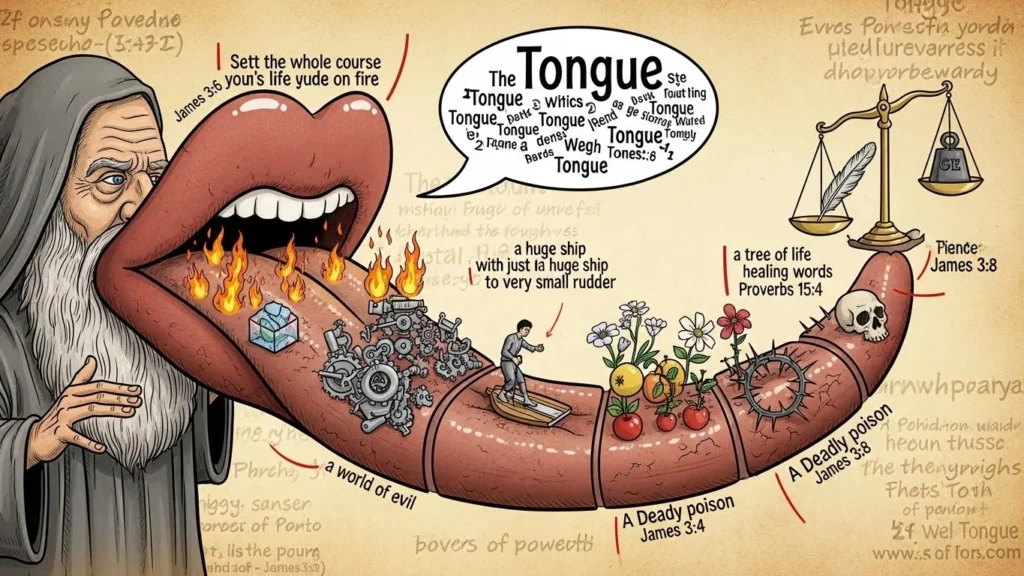

James 3:5–6
“The tongue is a small part of the body, but it makes great boasts. Consider what a great forest is set on fire by a small spark.” (NIV)
James warns that the tongue, though small, has enormous influence.
Our words can spread harm quickly — like fire through a forest. This verse urges us to use our tongues for truth and kindness, not destruction.
Proverbs 18:21
“The tongue has the power of life and death, and those who love it will eat its fruit.” (NIV)
Every word we speak plants a seed — for life or for harm.
God gives us the responsibility to speak words that bring healing, encouragement, and faith. Speaking life honors Him and blesses those around us.
Ephesians 4:29
“Do not let any unwholesome talk come out of your mouths, but only what is helpful for building others up.” (NIV)
Our words should lift others, not tear them down.
When we speak with kindness, truth, and love, our conversations become instruments of grace that reflect Christ’s heart.
Proverbs 15:1
“A gentle answer turns away wrath, but a harsh word stirs up anger.” (NIV)
The tone of our speech can calm storms or create them.
Responding gently in tense situations brings peace. Godly self-control in our words diffuses conflict and shows spiritual maturity.
Matthew 12:36–37
“But I tell you that everyone will have to give account on the day of judgment for every empty word they have spoken.” (NIV)
Jesus reminds us that our words matter — eternally.
We will give account for what we say, whether careless or cruel. This truth encourages us to speak thoughtfully and truthfully in every conversation.
Proverbs 21:23
“Those who guard their mouths and their tongues keep themselves from calamity.” (NIV)
Wise people think before they speak.
Guarding our words helps us avoid unnecessary pain, broken relationships, and regret. Silence, at times, can be the most spiritual response.
Colossians 4:6
“Let your conversation be always full of grace, seasoned with salt, so that you may know how to answer everyone.” (NIV)
God calls us to speak graciously and thoughtfully.
Words “seasoned with salt” are wise, kind, and truthful — leaving others better, not bitter. When grace fills our speech, God’s love shines through.
Psalm 141:3
“Set a guard over my mouth, Lord; keep watch over the door of my lips.” (NIV)
This prayer captures the heart of every believer seeking control over speech.
Only God can truly tame the tongue. Asking Him to guard our lips keeps our words aligned with His will.
James 1:19
“Everyone should be quick to listen, slow to speak and slow to become angry.” (NIV)
Listening before speaking is a mark of wisdom.
This verse reminds us that restraint is powerful. When we pause, pray, and reflect before responding, we often speak with more love and clarity.
Proverbs 12:18
“The words of the reckless pierce like swords, but the tongue of the wise brings healing.” (NIV)
Our words can either wound or heal.
A wise tongue brings comfort and peace, while reckless speech causes lasting pain. Choosing gentle words shows Christ’s compassion.
Theological Overview
The Bible presents the tongue as both a blessing and a burden. God designed speech to glorify Him and to build relationships. However, because of sin, our words often become instruments of pride, deceit, or harm.
Theologically, speech reflects the condition of the heart. Jesus said, “Out of the abundance of the heart the mouth speaks” (Matthew 12:34). What we say reveals what’s inside us.
God calls believers to sanctify their speech — to let the Holy Spirit guide every word. The tongue, when surrendered to God, becomes a powerful tool for worship, encouragement, and truth.
Practical Application
-
Pray daily for self-control. Ask God to help you speak wisely and calmly.
-
Pause before responding. Silence gives space for the Spirit to guide your words.
-
Encourage others. Speak blessings instead of complaints or gossip.
-
Avoid harmful talk. Stay away from lying, slander, or manipulation.
-
Speak Scripture. Let God’s Word shape your vocabulary and your attitude.
When your tongue is surrendered to God, your speech becomes a channel of His grace.
Short Prayer
Heavenly Father,
Help me to use my words to honor You. Guard my tongue from anger, gossip, and negativity. Fill my mouth with words of truth, love, and encouragement. Let every conversation reflect Your kindness and wisdom. In Jesus’ name, Amen.